I already talked about the reading project QuestingOrc and I have planned earlier here, and now it finally begins – yay! For the first stage we read the foreword as well as the first chapter. Earlier this week I received Orc’s first letter (so many firsts!): I scanned the pages and transcribed them below.
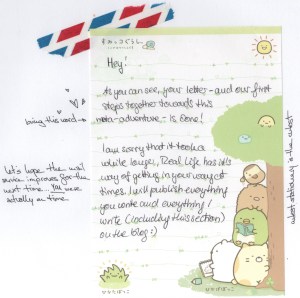 Hey!
Hey!
As you can see, your letter – and our first steps together towards this meta-adventure – is done!
I am sorry that it took a while longer, real life has it’s way of getting in your way at times. I will publish everything you write and everything I write (including this section) on the blog:
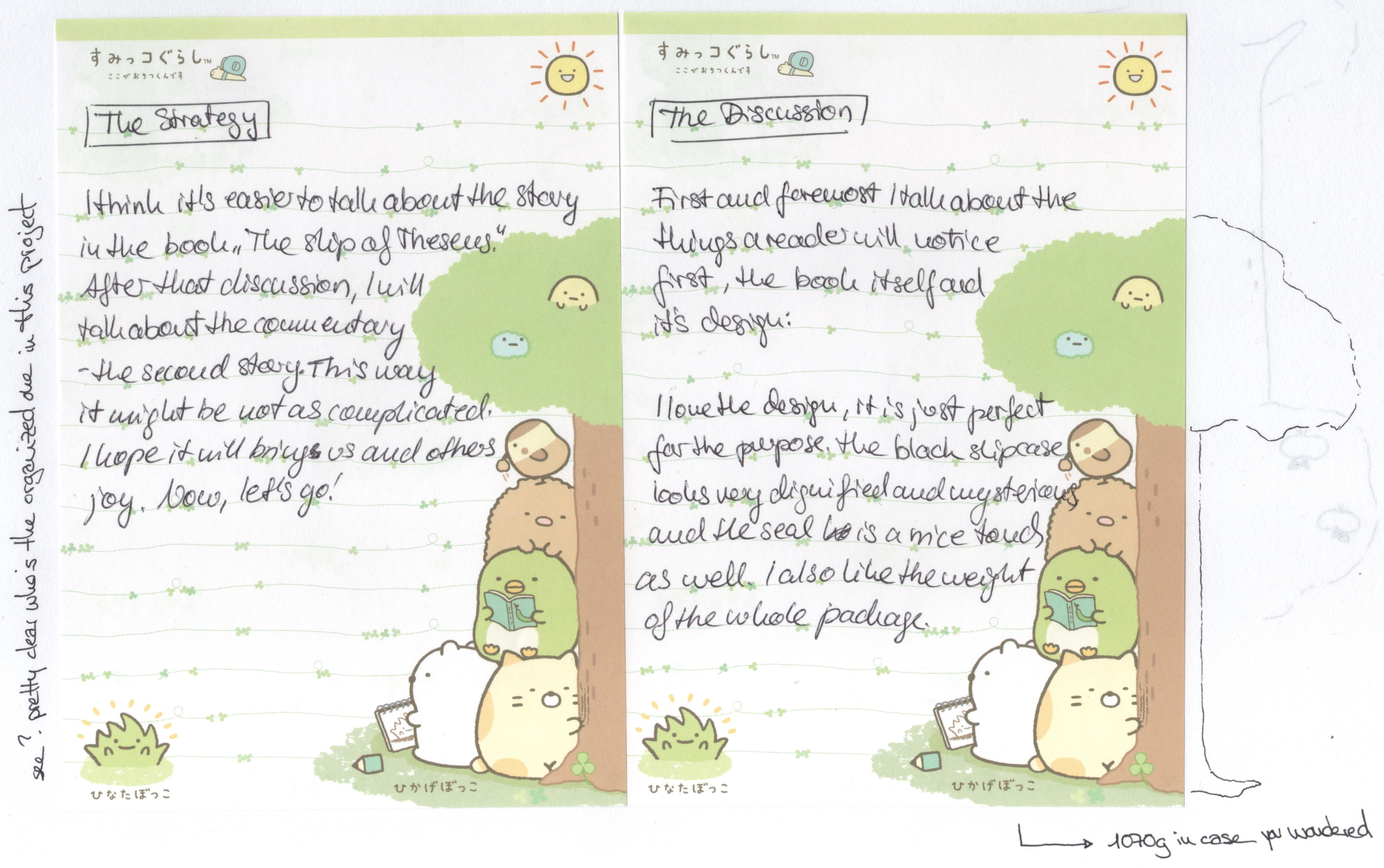
The Strategy
I think it’s easier to talk about the story in the book „The Ship of Theseus“. After that discussion, I will talk about the commentary – the second story. This way it might be not as complicated. I hope it will bring us and others joy. Now, let’s go!
 The Discussion
First and foremost I talk about the things a reader will notice first, the book itself and its design.
I love the design, it is just perfect for the purpose. the black slipcase looks very dignified and mysterious and the seal is a nice touch as well. I also like the weight of the whole package.
 Opening it, I thought it was fun that this whole book has this used look, with some smudge on the pages, just awesome.
Not to mention all the extra scribblings, articles, even maps and postcards that just peak outside a little.
It’s so intriguing but we all have to 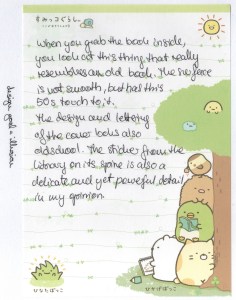 restrain ourselves I guess.
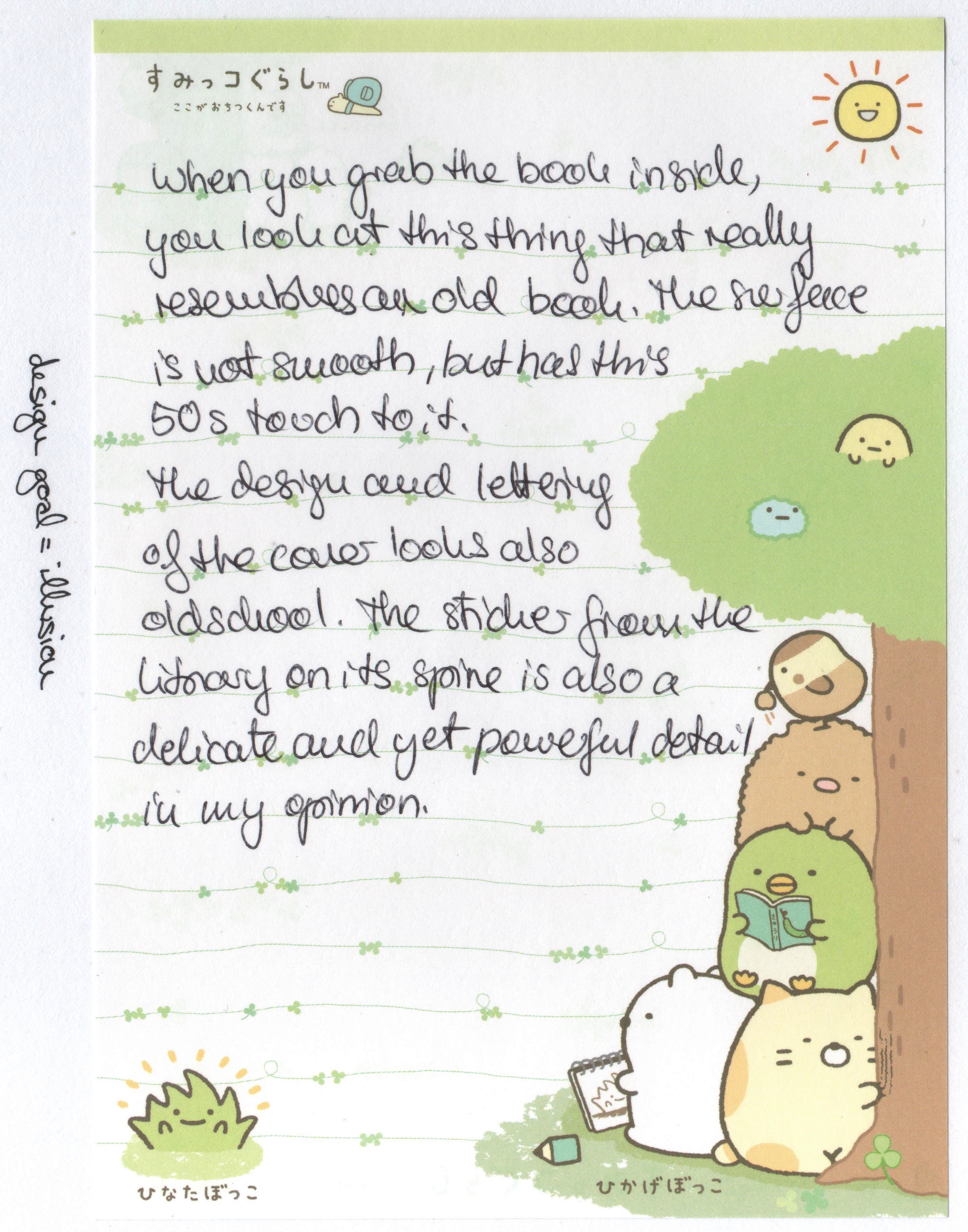
When you grab the book inside, you look at this thing that really resembles an old book. The surface is not smooth, but has this 50s touch to it. The design and lettering of the cover looks also oldschool. The sticker from the library on its spine is also a delicate and yet powerful detail in my opinion.

Translator’s note and foreword
- Straka, the Batman and Bond of authors!
- Before university, I would not recognize the value of forewords… You really get the gist from the book, especially in academic writing.
- Many „I“s in the text, I also do that a lot. Oh my.
- It’s written pretty personal and „I know something you don’t – like, also very passionate.

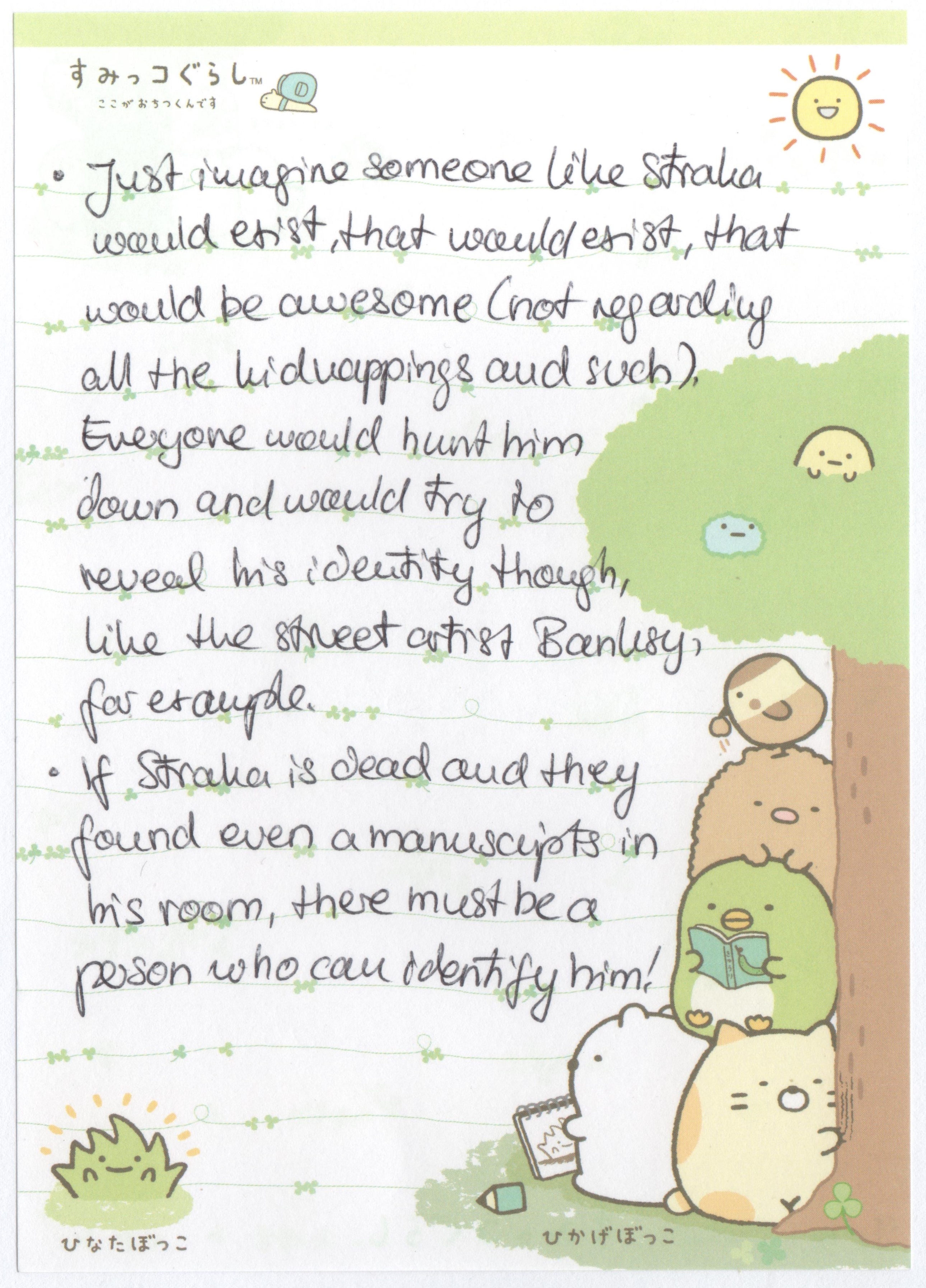
- Just imagine someone like Straka would exist, that would be awesome (not regarding all the kidnapping and such). Everyone would hunt him down and would try to reveal his identity though, like the street artist Banksy for example.
- If Straka is dead and they found even a manuscript in his room, there must be a
person who can identitfy him!
- „Straka was not just a storyteller, he was a story“ = Giveaway? Maybe just
imagination a dissociative personally disorder? -> „It is in the fondest regions of my heart and mind that my connection with V. M. Straka began, and it is where it shall end.“ (F. X. Caldeira)
The book of Theseus, Chapter 1
- The first few words really set the tone: Dust. Old. Dark. Cray. Smells.
- First paragraphs and you absolutely know that the protagonist and you, the reader, will be confused of what’s going on.
- The reader has the same impressions as the protagonists. Lost, not knowing where he is, where he comes from, who he is and what’s this all about.
 Gloomy atmosphere. Depressivestories about the environment.
- I found the woman with the wide hips and the room-sign interesting. Sign of struggling in life, trying to meet the bare neccessities.
- the books asks questions the reader might not ask: Why is the man wet? (Well, it’s raining, duh.)
- Page 6: First time S-Symbol is mentioned
- This chapter has all elements of a
rough, tough, adventurous, cthulhu-esque story.)
 Chapter name: ‚What begins – what ends‘ is it maybe a loop? We see here the end of the story?
- „What begins at the water shall end there and what ends here shall once more begin“ <- hint?
- Neptune, yeah! I should read more about mythology.
- Don Quixote – is mentioned, is the woman or the protagonist insane and fights a ridiculous/lost fight?
- He is afraid of showing his back, maybe he is not man but
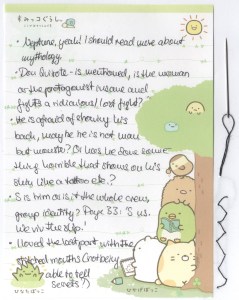 monster? Or has he done something horrible that shows on his skin like a tattoo etc.?
- S is him or is it the whole crew, group identity? Page 33: ‚S us. We viv the ship!
- I loved the last part with the stitched mouths (not being able to tell secrets?)
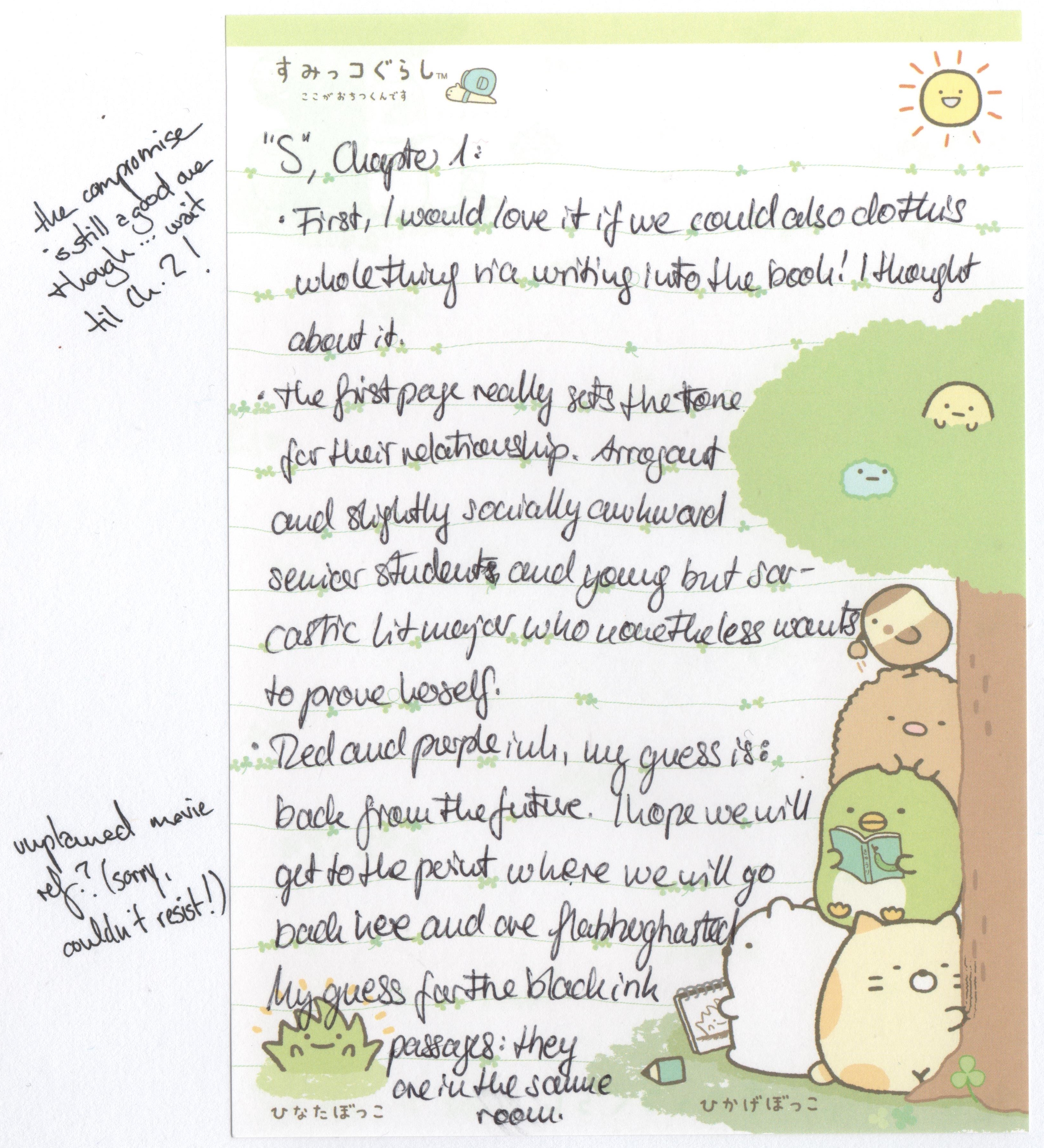
„S“, Chapter 1:
- First, I would love it if we could also do this whole thing via writing
 into the book! I thought about it.
- The first page really sets the tone for their relationship. Arrogant and slightly socially awkward senior student and young but sarcastic lit major who nonetheless wants to prove herself.
- Red and purple ink, my guess is: back from the future. I hope we will get to the point where we will go back here and are flabberghasted
My guess for the black ink passages: they are in the same room.
 The extra letter was fun! I loved how he provided the translation as well as the source material. Characteristical.
- More different colors, more timelines?
- xiii: Who drew the S?
- I like the whole detective chat! Also look at the distinctive hand-writing of them both.
- Uhh, personal drama and thrill[?]! I know people who’ve had bad relationships to their professors as well.
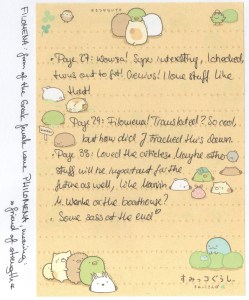
- Asking life’s questions: What does J want?
- VMS accusation list: haha… maybe, just maybe, Straka is a group!
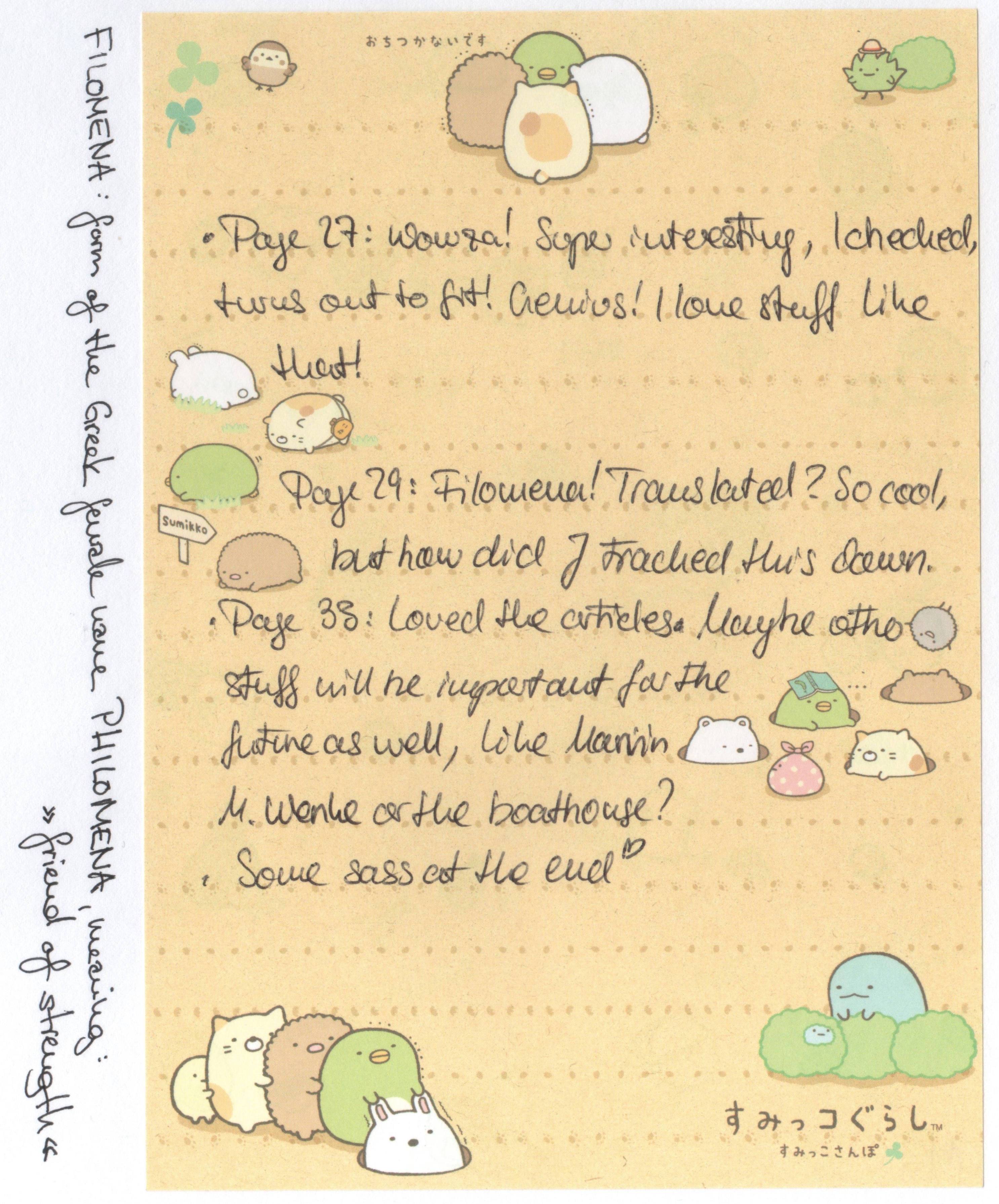
- Page 27: Wowza! Super interesting, I checked, turns out to fit! Genius! I love stuff like that!
- Page 29: Filomena! Translated? So cool, but how did J tracked this
down.
- Page 38: Loved the articles. Maybe other stuff will be important for the future as well, like Marvin M. Wenke or the boathouse?
- Some sass at the end ♥
That’s it!
Foreword and Chapter One – done!
I’m excited for your discoveries and opinion! ♥
Best,
QuestingOrc
To begin with: I really like how different we approached the letter writing! Yours is much more focused with the bullet points and reads a lot like actual commentary to the text. It really is a shame that we can’t pass around a copy of the book to actually write in it like Jen and Eric… It’s so much fun to read your thoughts on S. already! Some thoughts on your letter, my dear Orc:
The design of this book is so crazy gorgeous and beautiful, I really would love some commentary on how they made it. Probably going to dig around for some interviews after we’ve finished the book to avoid spoilers. If you turn the page and find some extra material sitting between the next two pages, do you first look at the material or the pages? I first read the story and footnotes (if there are some), than the comments by Jen and Eric before looking at the material (I also really love how the pieces are included in the story contrary to put them all for example in an envelope at the back!).
I’m actually not very fond of forewords… I much prefer reading conclusions and epilogues. Now Filomela’s text isn’t your usual foreword and I’m curious what kind of text the Ship of Theseus actually is.
Straka seems to have had an enormous output of writing and all the little comments by Jen and Eric make me so curious about his other books! You know, somehow this list of things he has supposedly done while remaining such a mystery reminded me a bit of Lemony Snicket… but Banksy is a good comparison too! Do you know about the uncovering of the author Robert Galbraith? I could imagine something like that happening to a real life Straka too!
The issue of Straka’s death… a manuscript could possibly have his name typed on it somewhere and if he used a well-known pseudonym for booking his room, he could be identified by it. But really, it did sound a bit staged to me. Like either him ditching Caldeira or someone not wanting them to meet. Straka as a sort of alter ego of Caldeira or other personality? That’s an interesting idea although I’m not sure it adds up just yet.
The story in the first chapter is rather slow and doesn’t really hook me on its own. I wonder what is yet to come and whether the story only asks questions or also provides answers. I’m not sure if S. just happens to be stranded in the worst part of town or the entire place is gloomy and rotten.
The letter s is everywhere in the text! Pretty creepy and no coincidence. Jen and Eric both deny drawing it and although they aren’t reliable, I do believe them here. Maybe Moody or Ilsa read their comments in between the swaps? Or there is another party all together? (The book approves of paranoia, I’m sure!).
H. P. Lovecraft is an author I really need to read sometime soon.
Still depending on what happens in between, it being a loop and the book maybe ending with S going into the water? That would be brilliant! But in that case I really want it to be a conscious decision by him.
Maybe he is afraid of showing his back because it would make him vulnerable? Even more than he already is? Your idea of him being „not man but monster“ makes me wonder whether S himself should be conceived as a good or bad character. Wouldn’t it be interesting if we’d learn later that losing his memory was some sort of punishment for being evil?
Hmm, I don’t believe the crew identifies as S. Seems more like VMS is using the accent to put the reader on a false trail. Have you watched the original trailers for S.? They don’t spoil you at this point but you do see a sailor and it makes the entire thing even creepier! Reminded me of the Día de Muertos too.
So far I am so much more interested what happens outside the text with Jen and Eric – especially if their future selves make comments on their past notes! Eric has been obsessed with the work of Straka for years and Jen is gradually being pulled into it all. For the black ink – I find it strange that they both use the same color in that timeline. Your guess is interesting but I wonder: if they were in the same room, why write the comments down? I mean, unless something isn’t right and one or both can’t talked? Another funny thing: Jen’s writing is rather girly while Eric writes very neat. I don’t know any guy who’s handwriting is so readable!
In a way I nearly wished he wouldn’t provide the translation – it would engage the reader as we would have to research ourselves… but on the other hand I’m glad they do the encoding for us as well so I won’t complain (I am very bad at codes).
You know what would interest me? Why is Straka apparently such a big number (Moody and Eric both want to publish about him and it sounds like that race is important at least in academic circles; we’ve the long list of Straka’s exploits and enemies etc.) who left a rather big canon of work – and how could he drift into obscurity?Shouldn’t Jen probably have heard of him as a lit student before finding Eric’s book? But she hasn’t. So what happened (or better: who?)?
At times Eric sounds like a mentor to Jen, loving their relationship so far!
Straka as a group reminds me of the whole debate around Shakespeare… also The S!
I’m at the stage where I write down nearly every mentioned name because I believe it will be important later… the density of the text is so exciting! Water in general seemingly is another important theme in Ship of Theseus.
Looking forward to your post and points to my letter… I’m rather sorry that you have to transcribe so much, I did get a bit overboard lost. On a side note: my notebook managed to be the only wet article in my bag the other day which was curious all by itself. Thankfully it dried up all nicely and without too much dissolved text but still… leaving it on my desk from now on to keep it safe! Do you use a notebook or simply write some notes down on a pad while reading?
—You can find my letter at Orc’s blog here —
Anyway, for the second stage we’ll read Chapter 2: The Drifting Twins. Considering Straka didn’t gave the titles but his trusted translator. I am curious what awaits us.
So long, and thanks for all the fish!








 poesielos.blog